
Last updated: September 2026
We track every product launched on Product Hunt. Over 173,000 of them, across 487 indexed topics. Every few months, we pull the data and look for patterns.
The first half of 2026 told a clear story - and a few surprising ones.
AI Didn't Just Win. It Absorbed Everything.
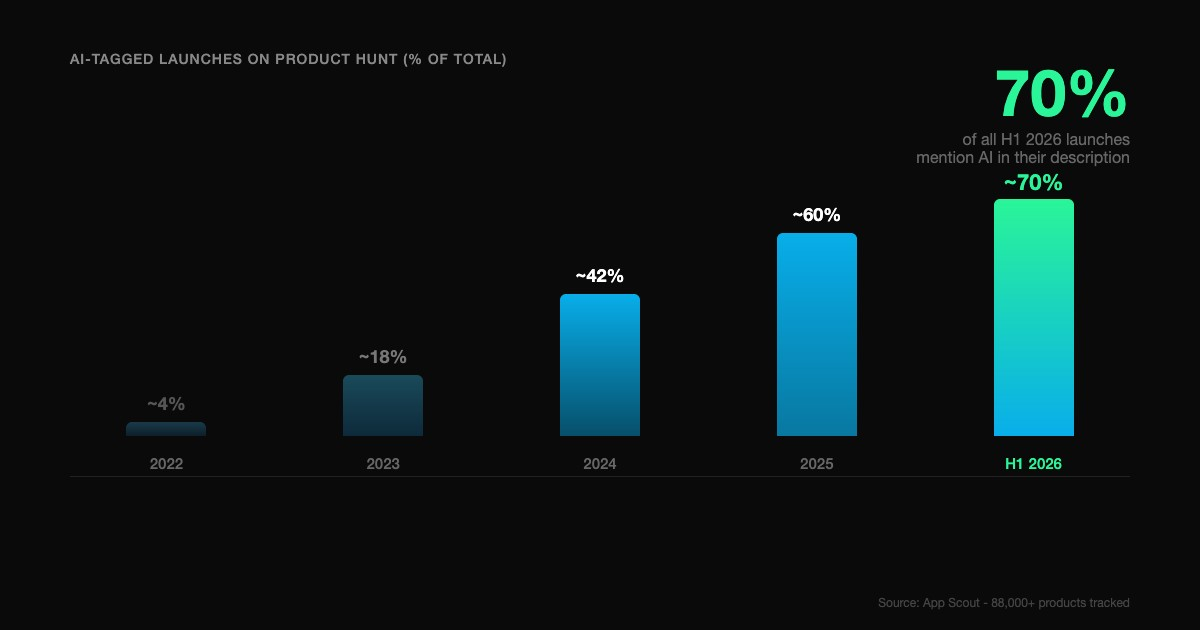
Open Product Hunt on any random day in 2026. Roughly 7 out of 10 launches have "AI" somewhere in the description. That's not hyperbole - it's what the data shows.
But the interesting part isn't the prevalence. It's the verb shift.
In 2024, AI products were tools you operated: "Upload your data, get insights." In 2025, they became assistants: "Tell me what you want, I'll draft it." In 2026, they're agents: "Here's my goal, figure out the steps yourself."
The word "use" became "delegate."
That single shift explains most of the trends below.
The Monthly Rotation Nobody Reports
AI trends on Product Hunt rotate on a roughly monthly cycle. We noticed this in the data and haven't seen anyone else mention it:
- January-February: Agent runtimes, code review tools
- March: AI design tools, agent marketplaces
- April: Meeting notes, eval frameworks
- May-June: Agent commerce, voice agents
Each wave lasts 4-6 weeks, peaks, then fades as the next one arrives. The category stays "AI" but the flavor keeps changing.
For makers, this matters. Launching an AI code review tool in April (when the spotlight was on design tools) means shouting into the wrong room. Time your launch to the current rotation.
Categories That Actually Grew (Not AI)
AI dominates the headlines. Meanwhile, some non-AI categories are quietly having their best year.
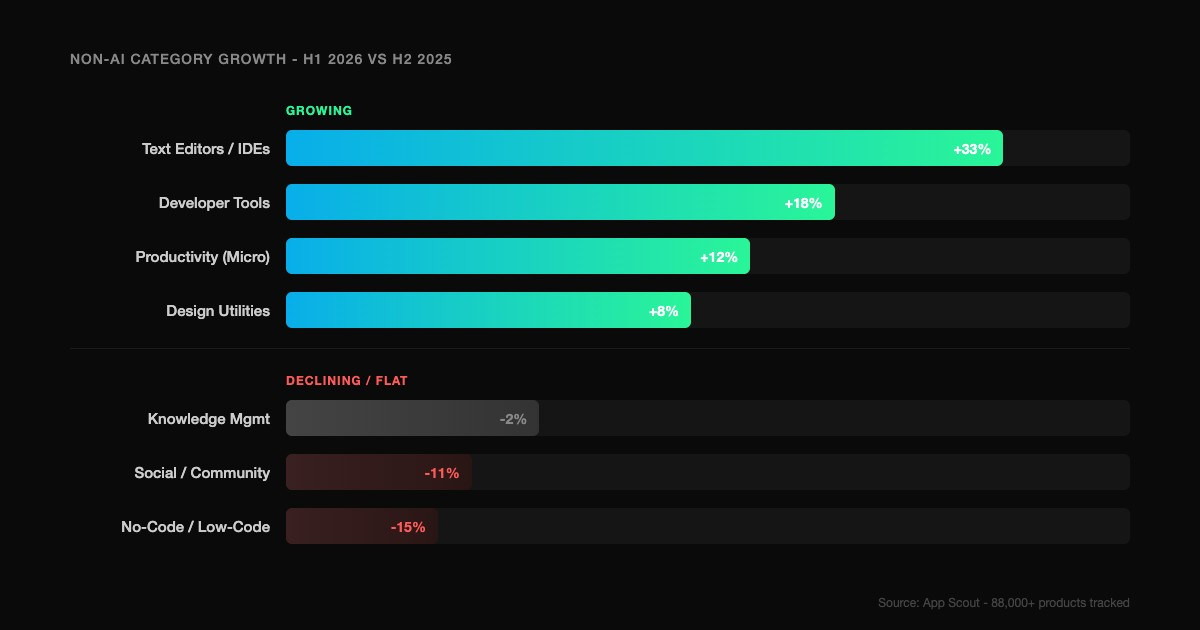
Text Editors and IDEs: +33% in Two Weeks
We flagged this in May: the fastest growth signal came from one of the smallest categories. Text editors aren't just editors anymore - they're becoming AI agent control panels. The surface where developers orchestrate autonomous coding workflows.
Developer Tools (Non-AI)
CLI utilities, testing frameworks, deployment pipelines - all maintained steady launch volume despite the AI wave. Developers still need plumbing that works without an LLM.
Productivity Micro-Tools
The "second brain" trend from 2025 plateaued. New productivity launches shifted toward single-purpose apps that do one thing and integrate via API. The era of all-in-one is over. People want composable.
What Happened to Last Year's Winners?
We tracked 50 products that hit #1 Product of the Day in 2025. Six months later:
- 35 (70%) still active and maintained
- 8 (16%) pivoted significantly from their launch positioning
- 4 (8%) went quiet (no updates in 3+ months)
- 3 (6%) shut down entirely
70% survival. Higher than most people expect. Product Hunt launches aren't just vanity metrics - the products that get traction tend to stick around.
The Upvote Economy
The threshold keeps climbing. In 2024, 500 upvotes could win the day. In 2025, you needed 700+. In 2026, #1 products regularly cross 1,000.
But upvote count correlates less with long-term success than engagement rate. Products with fewer upvotes but more comments tend to have better 6-month survival rates.
Comments signal genuine interest. Upvotes signal curiosity. Build for the people who comment.
What This Means for H2 2026
The AI agent window is closing - not because agents are going away, but because the novelty premium is fading. In January, "AI agent for X" was enough to get attention. By June, you needed "AI agent for X that does Y better than existing agents." Every month the bar rises.
Non-AI niches? Underserved. While everyone chases the AI wave, categories like developer tools, design utilities, and productivity micro-apps have less competition and equally engaged audiences. If you're building something that doesn't need an LLM, you might actually stand out more by not having one.
And the products that performed best weren't the ones with the best models. They were the ones with unique data. Proprietary datasets, novel integrations, domain-specific training data. That's what separates a weekend project from a product.
These insights come from App Scout, where we track Product Hunt trends across 59 active categories.
Explore the data yourself at App Scout - it's free →
FAQ
How many products launch on Product Hunt per day? On average, 80-120 products launch daily. Of these, roughly 10-15 get "Featured" by the editorial team.
What's the upvote threshold for #1 Product of the Day in 2026? It varies by day and competition, but we're consistently seeing winners cross 1,000 upvotes in H1 2026. Mid-week days (Tuesday-Thursday) tend to require higher counts due to more traffic.
Is Product Hunt still worth it for launching in 2026? A #1 Product of the Day typically drives 3,000-8,000 site visitors, 200-800 signups, and a permanent dofollow backlink from producthunt.com (DR 91). The 70% survival rate of top products suggests it's more than a vanity metric.
Which categories have the least competition right now? Non-AI developer tools, productivity micro-apps, and design utilities have maintained steady audience engagement while attracting fewer launches. Blue ocean territory compared to the AI agent space.