Building an app is the easy part. You have an idea, you know how to code, you ship it. That part is fun.
The hard part comes after. You launch, you look around, and you realize the landscape looks nothing like what you assumed. The category is either a bloodbath of funded competitors or a ghost town where nobody's buying. Either way, you're learning something you could have known weeks ago.
App Scout exists because that moment kept happening. And because the information to prevent it was always available - just never assembled in one place.
The moment after you ship
Every indie developer knows this feeling. You've been heads-down for weeks or months. You finally push the app live. And then you start actually looking at the market you just entered.
Sometimes it's fine. The competition is manageable, the category has demand, and your app carves out its space. But sometimes you discover things that would have changed your approach entirely.
The category is packed with thirty apps that all do roughly what yours does - some of them backed by full teams and years of iteration. Or the opposite: the category is so empty that the absence itself is the data point. No competition usually doesn't mean untapped opportunity. It means nobody's buying.
Or the timing is off. You built a tool in a category that was trending six months ago but has already peaked. The early movers captured the audience. You're arriving to a party that's winding down.
None of these are failures. The apps still work, the code is still good, and users still show up. But there's a difference between entering a market deliberately and stumbling into one. The first version lets you set realistic expectations, plan your positioning, and decide how much energy to invest in growth. The second version is just hoping things work out.
Why I started paying attention to market data
I don't build apps based on market research. I build what interests me, what solves problems I personally have. That's not going to change - it's the part of indie development I enjoy most.
But there's a step between "I built this thing" and "I'm going to actively market and grow this thing" where market data becomes genuinely useful. It's the moment you decide: is this a side project I maintain for fun, or is this something I push seriously?
That decision is a lot easier when you can see the competitive landscape clearly. When you know whether your category is growing or shrinking. When you can tell if the trend you're riding has momentum or if it already crested.
I started checking this stuff manually after every launch. App Store searches, Product Hunt browsing, Google Trends for category keywords, Reddit threads about similar tools. Each time it took hours, and each time I wished I'd done it sooner.
The analysis itself was interesting too. Watching which categories explode with new products every month, which ones quietly grow with almost no competition, which ones cycle through hype and settle into stable niches. There are patterns in market data that you can't see by building apps one at a time. You need the bird's-eye view.
That's what I wanted to build.
What existing tools get wrong
If you search for "app market analysis," you'll find Sensor Tower, AppFollow, MobileAction, AppMagic, and a dozen similar services. They're all built around the same use case: you already have an app in the store, and you want to track its rankings, monitor reviews, estimate competitor downloads, and optimize your listing.
They're post-launch monitoring tools. Every feature assumes you've already decided what to build, already built it, already shipped it. The entire product is designed around making your existing app perform better in the store.
They're also priced for companies, not individuals. Sensor Tower's market intelligence costs thousands per month. AppFollow's paid tiers start in the hundreds. If you're a solo developer evaluating three project ideas on a Sunday afternoon, spending $200/month on market intelligence doesn't make sense.
But the bigger problem isn't price. It's focus. These tools answer "how is my app doing?" That's an important question, but it's not the first question. The first question is "what's happening in this market right now?" And for that question - the strategic one, the one that shapes everything that comes after - there was nothing built for indie developers.
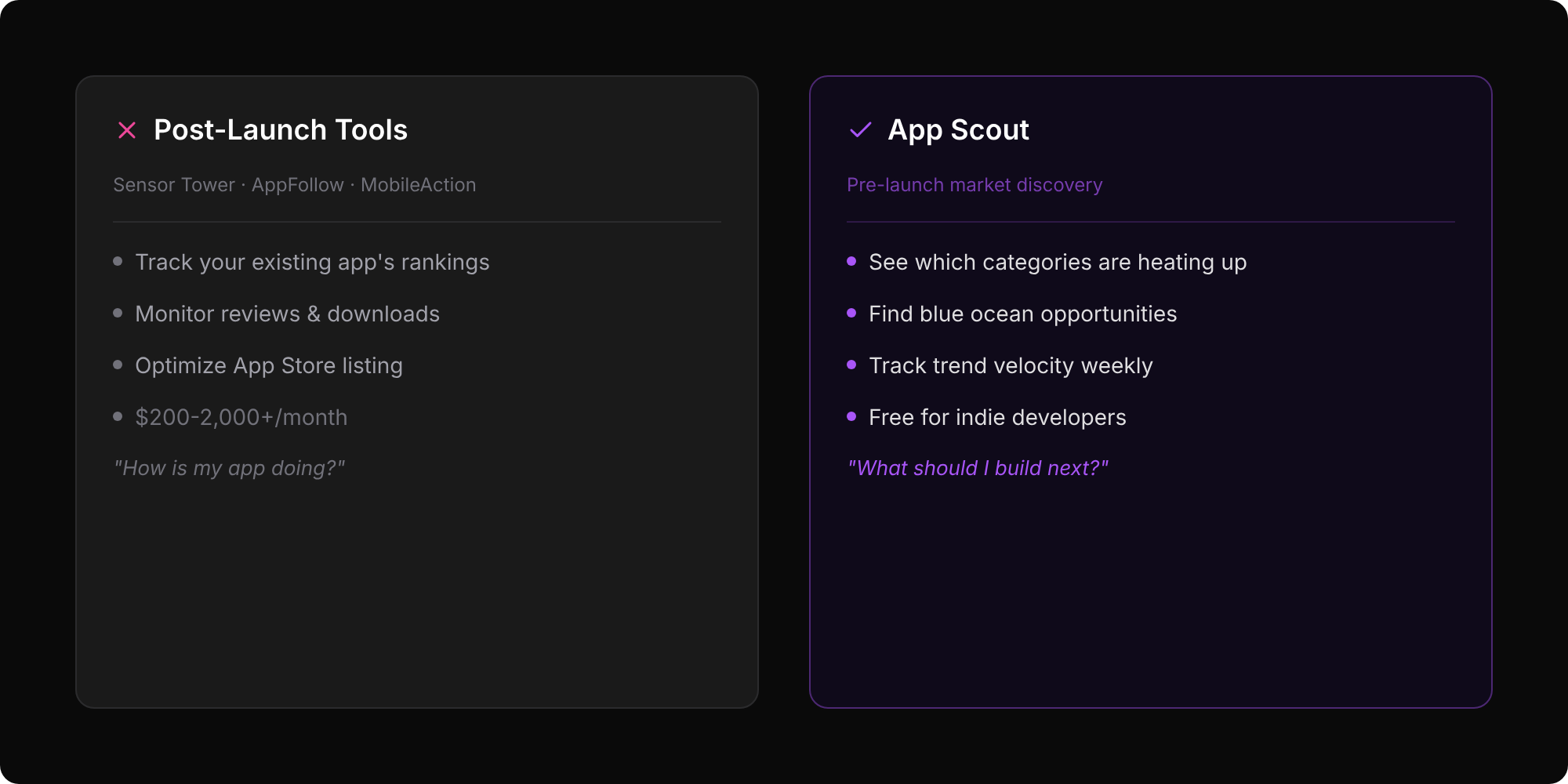
No tool showed you which categories are heating up across the entire app ecosystem. No tool identified gaps where demand exists but competition doesn't. No tool tracked trend velocity so you could distinguish a rising wave from a fading one.
Indie developers were left with manual research, gut feeling, or just not checking at all. Most chose the third option.
What App Scout does
App Scout tracks product launches across platforms - starting with Product Hunt, where 50 to 100 new products appear every single day - and turns that raw data into market intelligence that's useful for deciding what to build or how to position what you've already built.
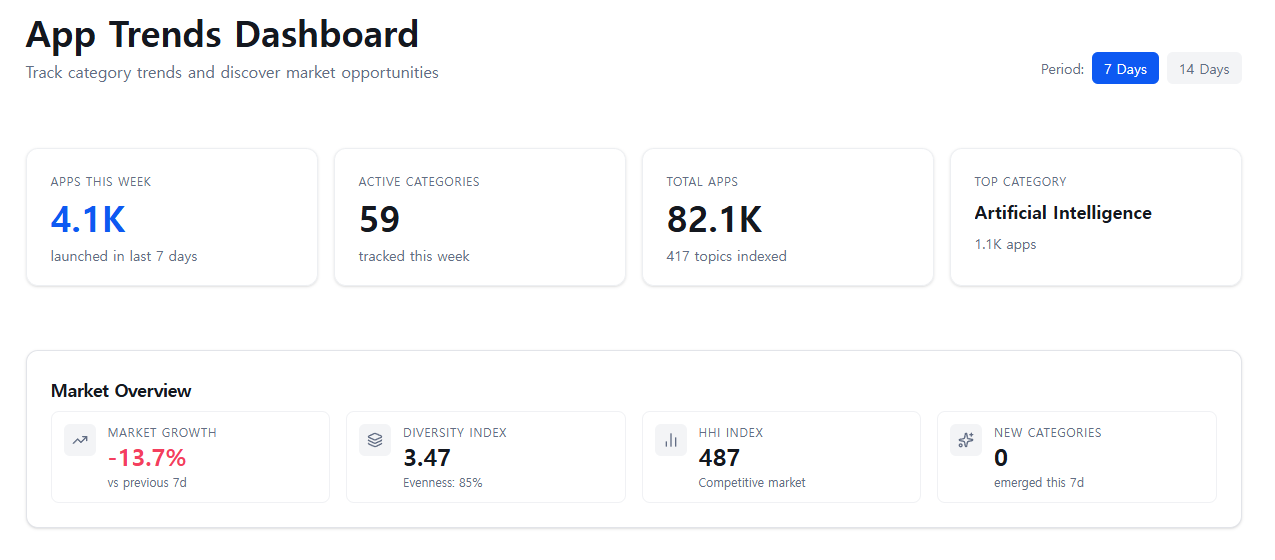
The dashboard gives you the bird's-eye view at a glance: how many apps launched this week, how many categories are active, and where the market concentration sits. The Market Overview panel breaks it down further - growth rate, diversity index, and competitive concentration (HHI) so you can see whether the ecosystem is spreading out or consolidating.
But the real value is in the category-level data.
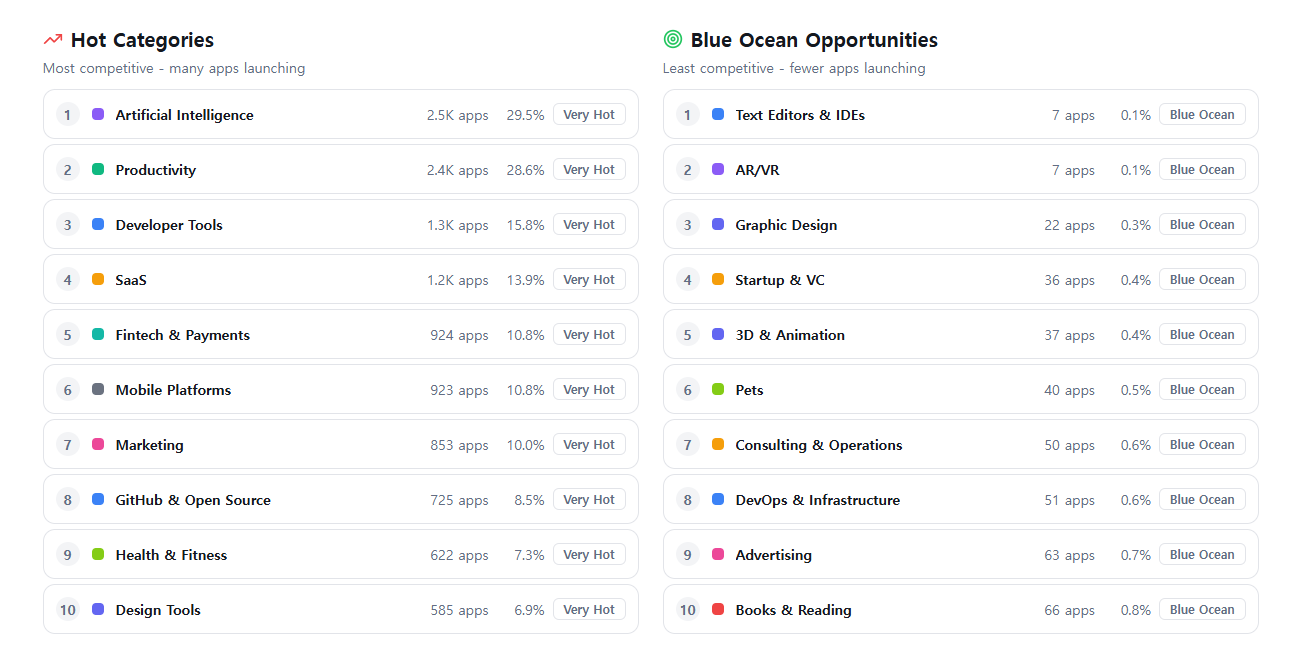
Hot categories. Which categories have the most launches right now? High launch activity means high competition. That's not automatically a reason to avoid a category - popular categories exist because there's real demand. But you should know what you're walking into. Discovering three months into development that your category has fifty established competitors is a different experience than knowing it on day one and planning accordingly.
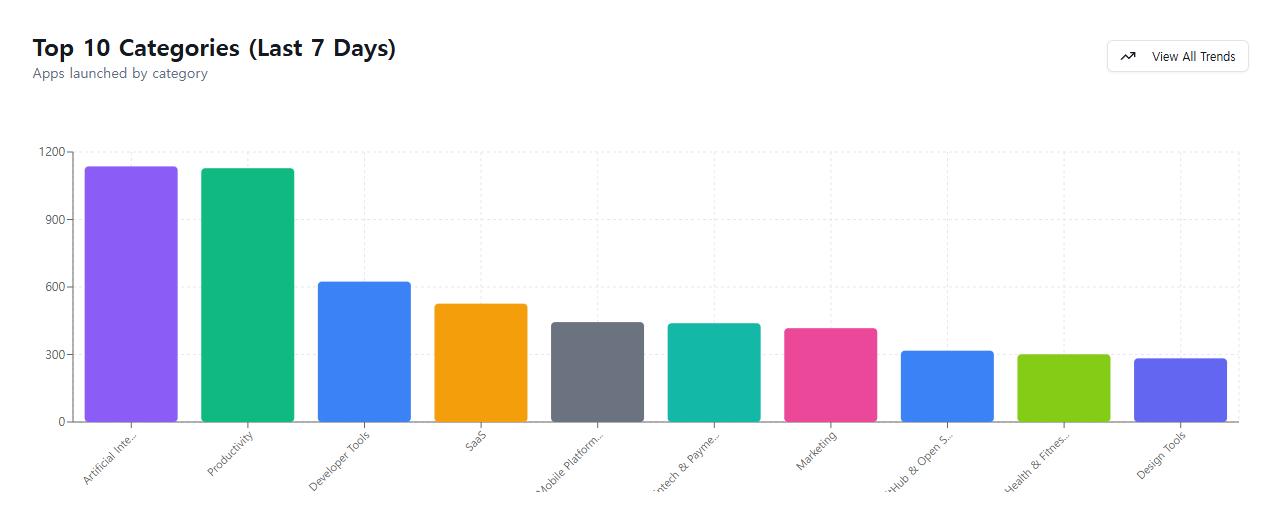
Look at the numbers: Artificial Intelligence has 2.5K apps at 29.5% market share. Productivity is right behind at 2.4K. If you're building in these spaces, you're competing against thousands. That's fine if you have a sharp angle. It's a disaster if you didn't know.
Blue ocean opportunities. Categories where user interest is growing but few new products are entering. These are the market gaps that are invisible if you're only looking at your own niche. Text Editors & IDEs has just 7 apps at 0.1% share. AR/VR sits at 7 apps. Graphic Design has 22. These are categories where a well-built product can actually stand out without drowning in competition.
A category might have strong search volume, active communities discussing the problem, and real willingness to pay - but only a handful of recent product launches. That imbalance is a signal, and it's one of the most valuable things App Scout surfaces.
Trend velocity. How fast a category's popularity is changing, week over week. This is where timing becomes visible. A category trending upward at 15% per week is a fundamentally different opportunity than one that peaked two months ago and is now declining at the same rate. Both might look identical in a snapshot. The trajectory tells you which one to bet on.
The weekly chart makes this concrete. You can see AI and Productivity dominating launch volume, with Developer Tools and SaaS forming a clear second tier. The drop-off from the top categories to the rest is steep - which means if you're building outside the top five, your competition is structurally lighter.
Performance benchmarks. Average engagement across categories - votes, comments, shares. Some categories consistently attract more attention than others, regardless of individual product quality. Building in a high-engagement category means your launch gets structural amplification. Building in a low-engagement category means even an excellent product might struggle for visibility. This isn't a quality judgment. It's about the physics of attention, and it's worth knowing before you invest months of work.
The core principle is simple: the biggest strategic decision in any project - which market to enter and when - should be informed by data. Everything after that decision, from architecture to marketing, flows downstream from it.
Why Product Hunt is the starting signal
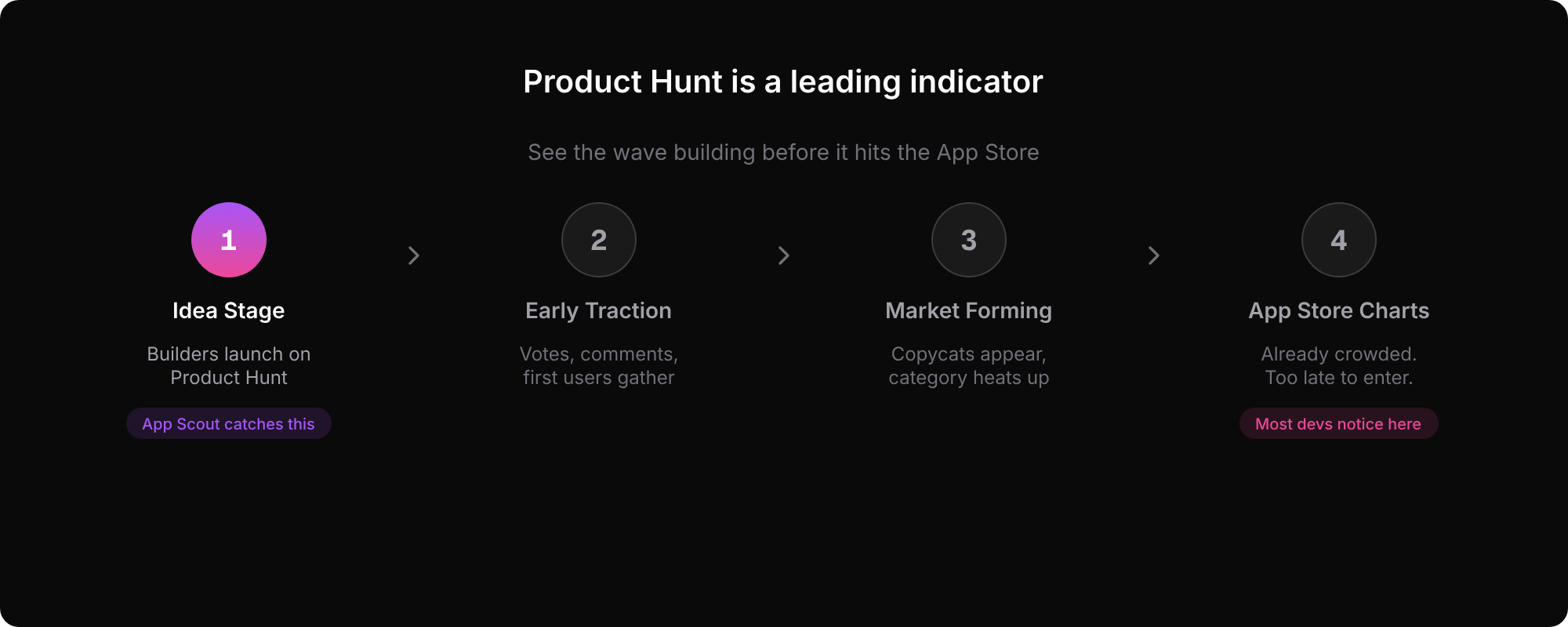
App Scout starts with Product Hunt data rather than App Store data directly, and the reason is straightforward: Product Hunt captures builder intent before it reaches the store.
When someone launches on Product Hunt, they're revealing what they believe the market wants right now. It's a leading indicator. By the time a trend shows up in App Store top charts, the early movers have already established themselves. Product Hunt shows you the wave while it's still forming.
The volume matters too. With 50 to 100 launches daily, Product Hunt provides a real-time census of what the global builder community is working on. Patterns that would take months to notice through casual browsing become visible in days when you look at the aggregate data. You can see an AI subcategory go from three launches per week to twenty in a single month. You can spot a utilities niche that's been growing steadily for six weeks with almost no new entrants.
Product Hunt is the starting point, not the whole picture. More data sources are on the roadmap - Indie Hackers, Hacker News Show HN, Reddit's build-in-public communities, and others. Each platform captures a different angle on what builders are doing and what users are requesting. Combining those signals will sharpen the picture further.
Who benefits from this
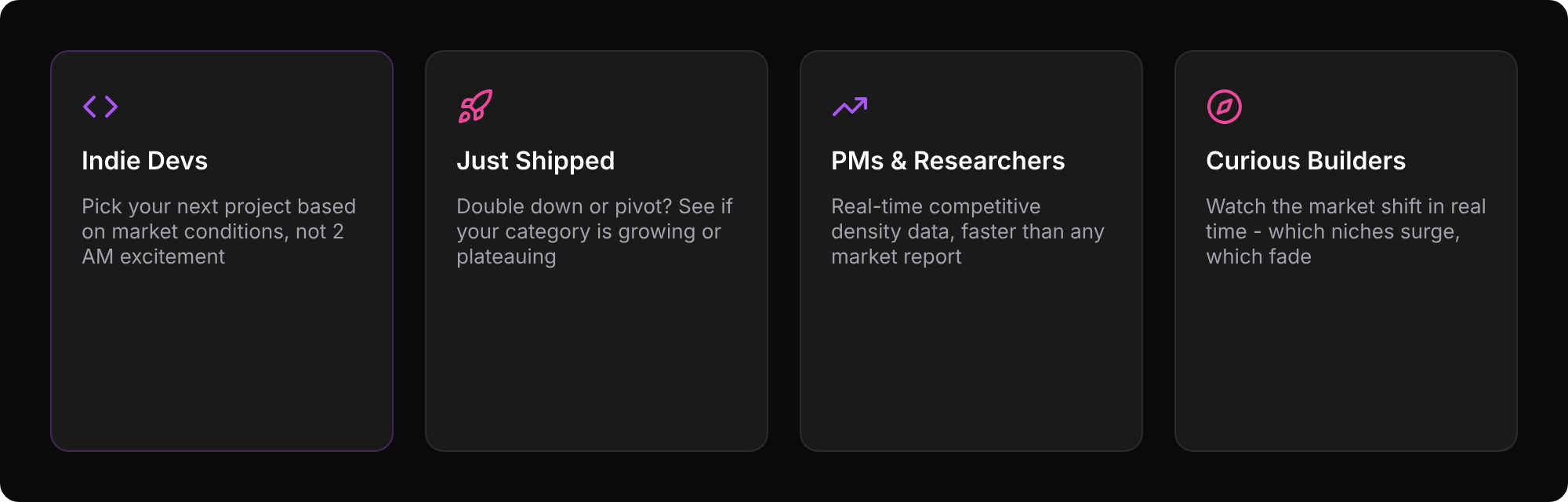
Indie developers evaluating project ideas. If you have two or three app ideas competing for your limited time, App Scout shows you which market gives you the best structural advantage. Not which idea is coolest - which market conditions favor a new entrant right now. Time is the scarcest resource for solo developers. Spending it in a market with tailwinds instead of headwinds changes the outcome more than any feature decision.
Developers who just shipped and need to decide what's next. You finished v1, it's stable, and now you're wondering: do I double down on this category or start something new? App Scout shows you whether your current category is growing or plateauing, and whether adjacent categories offer better opportunities for your next bet.
Product managers researching new directions. If your team is evaluating category expansion or a new product line, App Scout provides competitive density and trend data based on actual launch activity. It's faster than commissioning a market study and more current than any static report.
Anyone who finds market patterns interesting. Even without a specific project in mind, watching which categories are surging, which are emptying out, and which are cycling through hype is fascinating. The app ecosystem tells a story about what people want and what builders think people want - and those two things don't always align. The gaps between them are where the best opportunities hide.
What's next
App Scout is live and tracking data daily. The immediate roadmap is expanding data sources beyond Product Hunt, refining the trend algorithms as more historical data accumulates, and adding category-level alerts so you can get notified when a market you're watching changes significantly.
The long-term goal is simple: make "what should I build?" as data-informed as "how should I build it?" The development side of indie apps has incredible tooling - Xcode, SwiftUI, TestFlight, CI/CD pipelines. The strategy side has almost nothing. App Scout is the beginning of fixing that imbalance.
Try it
App Scout is free. Check the market before your next project - or check the market your current project is in.