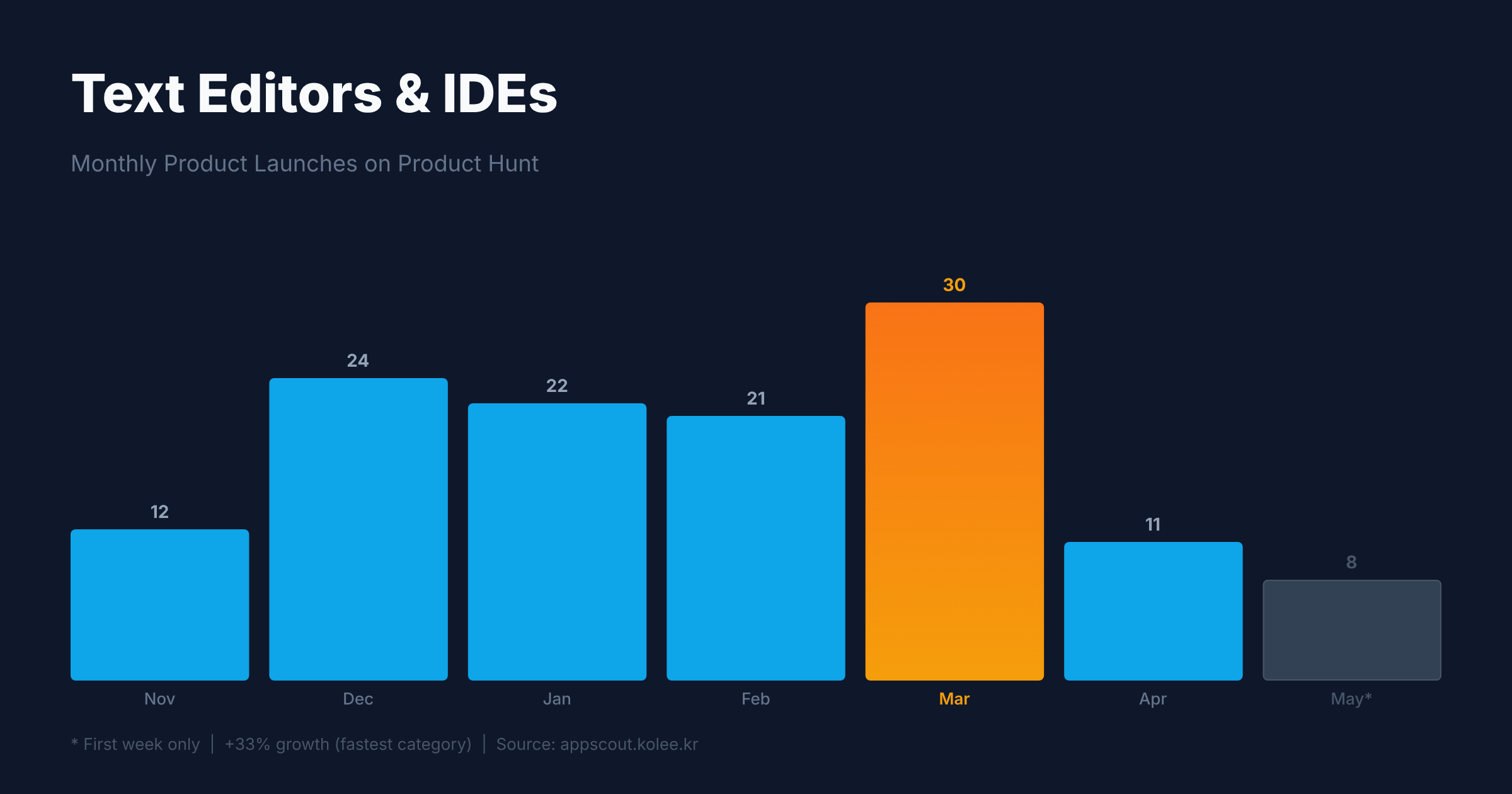
A few weeks ago, I was checking App Scout's category data and noticed something unusual. Text Editors & IDEs - a category that had been sitting quietly at the bottom of the charts for months - posted the highest growth rate of any category on the platform. Up 33% in two weeks.
Not AI. Not SaaS. Not productivity tools. Text editors.
The absolute number was small: 6 products became 8. But in trend analysis, rate of change matters more than raw volume. And when the fastest-moving signal on a platform tracking 88,000 products comes from a category with less than 0.1% market share, that's worth investigating.
The numbers
Monthly new product launches in the Text Editors & IDEs category:
- Nov 2025: 12
- Dec 2025: 24 (+100%)
- Jan 2026: 22
- Feb 2026: 21
- Mar 2026: 30 (peak)
- Apr 2026: 11
- May 2026: 8 (first week only)
March was the volume peak. But the two-week growth comparison tells a different story. While every major category - AI, Developer Tools, E-Commerce, UX/UI Design - posted negative or flat growth, Text Editors & IDEs was the only category accelerating. +33.3%, the highest on the platform.
Small numbers can carry big signals. When a quiet category starts moving while everything else flattens, something structural is changing.
What's actually launching: editors as agent platforms
Here's where it gets interesting. The products entering this category aren't better text editors. They're something entirely new.
Kit
"Editor, Browser, Mail, Terminal, Agents. AI at the center." Five developer tools merged into one window with an autonomous AI agent that has context across all of them. Built-in browser, git panel, terminal, and something called "Stairs" that chains AI + shell + HTTP + file operations. Open source, MIT licensed.
Superset 2.0
"Run 100s of coding agents on any machine from anywhere." A rewrite that supports remote workspaces and parallel agent execution. The editor is a shell for orchestrating fleets of AI workers.
Herd
"Run a herd of AI coding agents from one window." Same day as Kit and Superset. Three agent-orchestration editors launched on the same day. That's not a coincidence - it's a market forming in real time.
Mintlify Editor
"AI-native collaborative editor." WYSIWYG, live-collaborative, git synced. The angle: agents update docs automatically while humans edit in the browser.
veloca
An open-source Markdown editor inspired by Typora, branding itself around "vibe writing." Even the traditional editors are adopting the AI-native vocabulary.
More recent entries
- Notelane - A free Markdown notes editor for iOS and iPadOS
- Modyak - Run Claude Code and Codex with any model
- Nexion - The AI-native workspace for macOS
- Remoot - Control VS Code & Cursor directly from your phone
There's a pattern. The new text editors aren't competing on syntax highlighting or tab management. They're competing on how many AI agents you can run simultaneously and how much context those agents share.
The vibe coding connection
This makes more sense when you look at adjacent data. The "Vibe coding" topic on Product Hunt went from 3 products per week in October 2025 to a peak of 36 per week by March 2026. That's a 12x increase in six months.
The first wave of vibe coding was standalone agents and AI features bolted onto existing tools. Cursor adding AI to VS Code. GitHub Copilot getting smarter. Claude Code running in the terminal.
The second wave - the one happening right now - is tools designed from scratch with AI agents as the primary user. The human writes a prompt. The agents write the code. The editor's job is managing that swarm.
That's why text editors are suddenly interesting again. It's not that people want a better way to type code. It's that "editor" is being redefined as "agent control panel."
Why small signals matter more than big ones
In market analysis, the most useful signals are almost never in the biggest categories. AI and Productivity dominate the charts every week - thousands of launches, predictable growth, well-understood dynamics. There's nothing surprising there.
The interesting signals hide in categories where the baseline is low enough that a small absolute change represents a large percentage shift. Text Editors going from 6 to 8 products in two weeks is a 33% jump. AI going from 800 to 810 is noise.
This is the core idea behind App Scout. When you track every product launch across an entire platform, you can spot these inflection points - the moment a quiet category starts moving, before the trend becomes obvious.
The Text Editors & IDEs category was flagged as a Blue Ocean opportunity months ago: low competition, underserved market. Now it's the fastest-growing category on the platform. That transition from "blue ocean" to "heating up" is the window where entering a market makes the most sense.
What to watch next
Based on the same data, a few categories are showing early signs of similar shifts:
- 3D & Animation (+19.4% growth) - likely driven by AI-generated 3D assets
- AR/VR (still tiny but consistent) - spatial computing tools starting to move
- Music & Audio - AI composition tools following the same pattern as code generation
The question isn't whether AI will reshape these categories. It's whether you'll see it happening before or after the market fills up.